This is such a good question and it’s really important for any woman questioning their orientation/attraction. I’m going to explain the difference using three specific examples of times when attraction gets confusing, but there are a ton of different ways compulsory heterosexuality manifests, so if none of these hit on what you’re feeling, feel free to shoot me another anon.
Attraction vs. Compulsory Heterosexuality
Nervousness and Blushing
A ton of romance media and common cultural tropes have this idea that you know you’re attracted to someone if you’re nervous or blushing around them. Because of this, you might feel like you must be attracted to a man if you feel nervous around him, just because you’re experiencing the physical bodily response you’ve been told to expect, not because you actually want to date him.
Actual Attraction: You’re nervous because you’re excited to get to know someone. You find them attractive first and because you’re thinking about your attraction to them, you get self conscious because you hope they might like you too.
Compulsory Heterosexuality: You’re nervous because you are aware that he is attracted to you, and because he’s paying such close attention to you– especially if he’s pushing boundaries or getting too close into your personal space– you become self conscious because you know he’s watching you. You blush because you’re uncomfortable.
Hypothetical Attraction
Many questioning women have a hard time sorting through their attraction because of hypotheticals. Our culture, in general, disregards or challenges wlw’s attraction and it gives this anxiety that we need to know 100% that we are not and will never be attracted to men no matter what in order to claim labels.
It’s hard to do that as a young person who is just learning about themselves, flooded with “what if”s about the future. Because of this, you might feel like you can’t rule out being attracted to men because you might hypothetically be attracted to one someday. Who knows?
Actual Attraction: You imagine a hypothetical future where you end up with a man and it feels exciting and makes you feel good and hopeful and happy and right. It’s a nice feeling and is comfortable to think about. Reassuring.
Compulsory Heterosexuality: You imagine a hypothetical future where you end up with a man and it makes you feel uncomfortable, scared, sad, disappointed, wrong. It’s an upsetting thing to think about and you hope it doesn’t happen. You don’t want to end up with a man even if you feel like you could.
Sexual Fantasies
Our culture places a big emphasis on sex when it comes to orientation. Some people’s orientation includes sexual attraction and some people’s orientation doesn’t, but most of us feel like our sexual fantasies are the most important indicator of non-straight sexuality because LGBPQ+ people have been so thoroughly reduced to sexual acts and sexual objects in the homophobic culture we’ve grown up in.
Along with that, we’ve also grown up in a heteronormative and cisnormative society that repetitively teaches and reemphasizes the same singular sexual “script” for how sex is supposed to go, over and over and over. They do not teach any others, and it requires non-straight and non-cis people to invent their own sexual scripts individually and with partners.
But as a young person, when you’re aroused, your mind has a very limited template of potential narratives associated with that feeling, so many people default to the same heteronormative script in their fantasies because it’s unconscious and easy. Because of this, you might feel like you must be attracted to men because you imagine abstract situations of sex with men, even though you have absolutely no desire to sleep with men in real life.
Actual Attraction: When you fantasize about men, it is because you’re attracted to their bodies or specific men or the idea of having sex with men. You imagine qualities of their body and you like the idea of what you’re imagining. If you think about the fantasy later that day, you might feel like it’s embarrassing, but you also feel like it’s sexy.
Compulsory Heterosexuality: When you fantasize about men, it is mostly just enacting a kind of narrative. More focused on movement than features– the men in your fantasies might be faceless or blank-featured or their bodies might symbolize some emotion. You don’t really like the idea of what you’re imagining. You might not even be in the fantasy, but instead another faceless woman might be. You might even imagine yourself as the man. The narrative follows the sexual script, but the details are more vague and abstract and might even shift and change throughout the fantasy. If you think about it later that day, you might feel vaguely nauseated or uncomfortable or feel invalidated and wrong.
It’s really difficult to unroot compulsory heterosexuality. My simplest advice on getting through it is this: even if you are attracted to men, you do not need to date them if you don’t want to. If you only want to date other women, then you have the right to that. The rest is less important than the simple reality of what you want right now.
Hi! My name is Stella and I’m writing my senior paper about asexuality. I have a survey that has a couple of questions that ask about your personal definitions/experiences with asexuality. If you could please take this survey, it would help me out a whole bunch! I need responses by December 18th, at around 9:30 ish AM, EST. The answers you give will remain confidential, only I will see them, and your name will not be mentioned in my paper, unless otherwise stated by you.
To give your responses, you must be asexual, that’s all.
my night manager (who is a gay man) and i sometimes sit down and exchange stories and tidbits about our sexuality and our experiences in the queer cultural enclave. and tonight he and i were talking about the AIDS epidemic. he’s about 50 years old. talking to him about it really hit me hard. like, at one point i commented, “yeah, i’ve heard that every gay person who lived through the epidemic knew at least 2 or 3 people who died,” and he was like “2 or 3? if you went to any bar in manhattan from 1980 to 1990, you knew at least two or three dozen. and if you worked at gay men’s health crisis, you knew hundreds.” and he just listed off so many of his friends who died from it, people who he knew personally and for years. and he even said he has no idea how he made it out alive.
it was really interesting because he said before the aids epidemic, being gay was almost cool. like, it was really becoming accepted. but aids forced everyone back in the closet. it destroyed friendships, relationships, so many cultural centers closed down over it. it basically obliterated all of the progress that queer people had made in the past 50 years.
and like, it’s weird to me, and what i brought to the conversation (i really couldn’t say much though, i was speechless mostly) was like, it’s so weird to me that there’s no continuity in our history? like, aids literally destroyed an entire generation of queer people and our culture. and when you think about it, we are really the first generation of queer people after the aids epidemic. but like, when does anyone our age (16-28 i guess?) ever really talk about aids in terms of the history of queer people? like it’s almost totally forgotten. but it was so huge. imagine that. like, dozens of your friends just dropping dead around you, and you had no idea why, no idea how, and no idea if you would be the next person to die. and it wasn’t a quick death. you would waste away for months and become emaciated and then, eventually, die. and i know it’s kinda sophomoric to suggest this, but like, imagine that happening today with blogs and the internet? like people would just disappear off your tumblr, facebook, instagram, etc. and eventually you’d find out from someone “oh yeah, they and four of their friends died from aids.”
so idk. it was really moving to hear it from someone who experienced it firsthand. and that’s the outrageous thing – every queer person you meet over the age of, what, 40? has a story to tell about aids. every time you see a queer person over the age of 40, you know they had friends who died of aids. so idk, i feel like we as the first generation of queer people coming out of the epidemic really have a responsibility to do justice to the history of aids, and we haven’t been doing a very good job of it.
Younger than 40.
I’m 36. I came out in 1995, 20 years ago. My girlfriend and I started volunteering at the local AIDS support agency, basically just to meet gay adults and meet people who maybe had it together a little better than our classmates. The antiretrovirals were out by then, but all they were doing yet was slowing things down. AIDS was still a death sentence.
The agency had a bunch of different services, and we did a lot of things helping out there, from bagging up canned goods from a food drive to sorting condoms by expiration date to peer safer sex education. But we both sewed, so… we both ended up helping people with Quilt panels for their beloved dead.
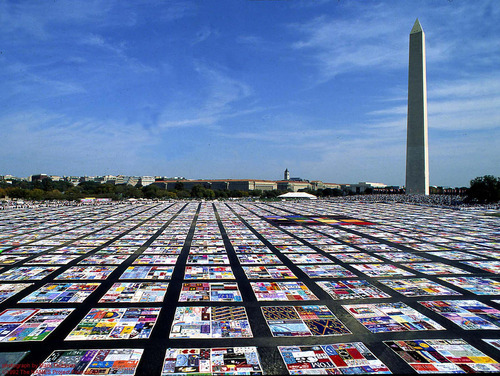
Do the young queers coming up know about the Quilt? If you want history, my darlings, there it is. They started it in 1985. When someone died, his loved ones would get together and make a quilt panel, 3’x6’, the size of a grave. They were works of art, many of them. Even the simplest, just pieces of fabric with messages of loved scrawled in permanent ink, were so beautiful and so sad.
They sewed them together in groups of 8 to form a panel. By the 90s, huge chunks of it were traveling the country all the time. They’d get an exhibition hall or a gym or park or whatever in your area, and lay out the blocks, all over the ground with paths between them, so you could walk around and see them. And at all times, there was someone reading. Reading off the names of the dead. There was this huge long list, of people whose names were in the Quilt, and people would volunteer to just read them aloud in shifts.
HIV- people would come in to work on panels, too, of course, but most of the people we were helping were dying themselves. The first time someone I’d worked closely with died, it was my first semester away at college. I caught the Greyhound home for his funeral in the beautiful, tiny, old church in the old downtown, with the bells. I’d helped him with his partner’s panel. Before I went back to school, I left supplies to be used for his, since I couldn’t be there to sew a stitch. I lost track of a lot of the people I knew there, busy with college and then plunged into my first really serious depressive cycle. I have no idea who, of all the people I knew, lived for how long.
The Quilt, by the way, weighs more than 54 tons, and has over 96,000 names. At that, it represents maybe 20% of the people who died of AIDS in the US alone.
There were many trans women dying, too, btw. Don’t forget them. (Cis queer women did die of AIDS, too, but in far smaller numbers.) Life was and is incredibly hard for trans women, especially TWOC. Pushed out to live on the streets young, or unable to get legal work, they were (and are) often forced into sex work of the most dangerous kinds, a really good way to get HIV at the time. Those for whom life was not quite so bad often found homes in the gay community, if they were attracted to men, and identified as drag queens, often for years before transitioning. In that situation, they were at the same risk for the virus as cis gay men.
Cis queer women, while at a much lower risk on a sexual vector, were there, too. Helping. Most of the case workers at that agency and every agency I later encountered were queer women. Queer woman cooked and cleaned and cared for the dying, and for the survivors. We held hands with those waiting for their test results. Went out on the protests, helped friends who could barely move to lie down on the steps of the hospitals that would not take them in — those were the original Die-Ins, btw, people who were literally lying down to die rather than move, who meant to die right there out in public — marched, carted the Quilt panels from place to place. Whatever our friends and brothers needed. We did what we could.
OK, that’s it, that’s all I can write. I keep crying. Go read some history. Or watch it, there are several good documentaries out there. Don’t watch fictional movies, don’t read or watch anything done by straight people, fuck them anyway, they always made it about the tragedy and noble suffering. Fuck that. Learn about the terror and the anger and the radicalism and the raw, naked grief.
I was there, though, for a tiny piece of it. And even that tiny piece of it left its stamp on me. Deep.
2011
A visual aid: this is the Quilt from the Names Project laid out on the Washington Mall
I was born (in Australia) at the time that the first AIDS cases began to surface in the US. While I was a witness after it finally became mainstream news (mid-85), I was also a child for much of it. For me there was never really a world Before. I’m 35 now and I wanted to know and understand what happened. I have some recommendations for sources from what I’ve been reading lately:
And the Band Played On: Politics, People and the AIDS Epidemicby Randy Shiltsis a seminal work on the history of HIV/AIDS. It’s chronological and gives an essential understanding of all the factors that contributed to the specific history of the virus’ spread through the US and the rest of the world, the political landscape into which it landed (almost the worst possible)*. Investigative journalism and eyewitness account. Shilts was himself an AIDS casualty in 1994.
Larry Kramer is a pretty polarising figure and he had issues with the sexual politics of gay New York to begin with (see: Faggots) but he’s polarising for a reason: he’s the epidemic’s Cassandra. Reports from the Holocaustcollects his writings on AIDS.
I don’t think I can actually bring myself to read memoirs for the same reason I can’t read about the Holocaust or Stalinist Russia any more. But I have a list:
Read or watchThe Normal Heart. Read or watch Angels in America. Read The Mayor of Castro Streetor watchMilk. Dallas Buyers Clubhas its issues but it’s also heartbreaking because the characters are exactly the politically unsavory people used to justify the lack of spending on research and treatment. It’s also an important look at the exercise of agency by those afflicted and abandoned by their government/s, how they found their own ways to survive. There’s a film of And the Band Played Onbut JFC it’s a mess. You need to have read the book.
Everyone should read about the history of the AIDS epidemic. Especially if you are American, especially if you are a gay American man. HIV/AIDS is not now the death sentence it once was but before antiretrovirals it was just that. It was long-incubating and a-symptomatic until, suddenly, it was not.
Read histories. Read them because reality is complex and histories attempt to elucidate that complexity. Read them because past is prologue and the past is always, in some form, present. We can’t understand here and now if we don’t know about then.
*there are just SO MANY people I want to punch in the throat.
Please, if you are following me right now, read this. It’s so important to remember this, to understand how much we lost. To understand that, when I was a little kid, the biggest thing about the community was that shared loss.
There is a lot I want to say and I don’t have the spoons but. Yeah. This is all so, so important. Please read this.
Wow, I’m sitting here biting my tongue so hard trying not to cry cause I’m in a room with my flatmates… I hate that i m so ignorant of all of this…
heres a rule of thumb for headcanons: dont take away already existing representation.
if a character is canonically a lesbian, don’t go “but what if she was bi?”
if a character is canonically a transboy, don’t go “but what if he was genderfluid?”
theres a multitude of straight and cis characters you can headcanon as whatever the hell you want to. leave the characters that already are canonically part of a marginalized group alone.

 Delicious Fish